Storm Damage Tree Service & Fallen Tree Cleanup in Ocala, FL
When Central Florida's fierce hurricane seasons and convective summer squalls sweep through Marion County, properties are left littered with shattered canopies, uprooted trunks, and hazardous overhead branches. If you need a reliable storm damage tree service, rapid fallen tree removal service, or complete tree cleanup near me, Tree Services Ocala FL provides heavy commercial extraction, precision tree limb removal near me, and comprehensive tree cutting and removal to restore your property safely.
- Restorative crown cleaning & hazard pruning following ANSI A300 standards
- Commercial chippers & log grapple loaders for thorough yard debris removal
- Detailed photographic damage logs & itemized billing for insurance claims
Request Storm Cleanup Estimate
Prompt on-site assessment for storm-damaged properties in Marion County.
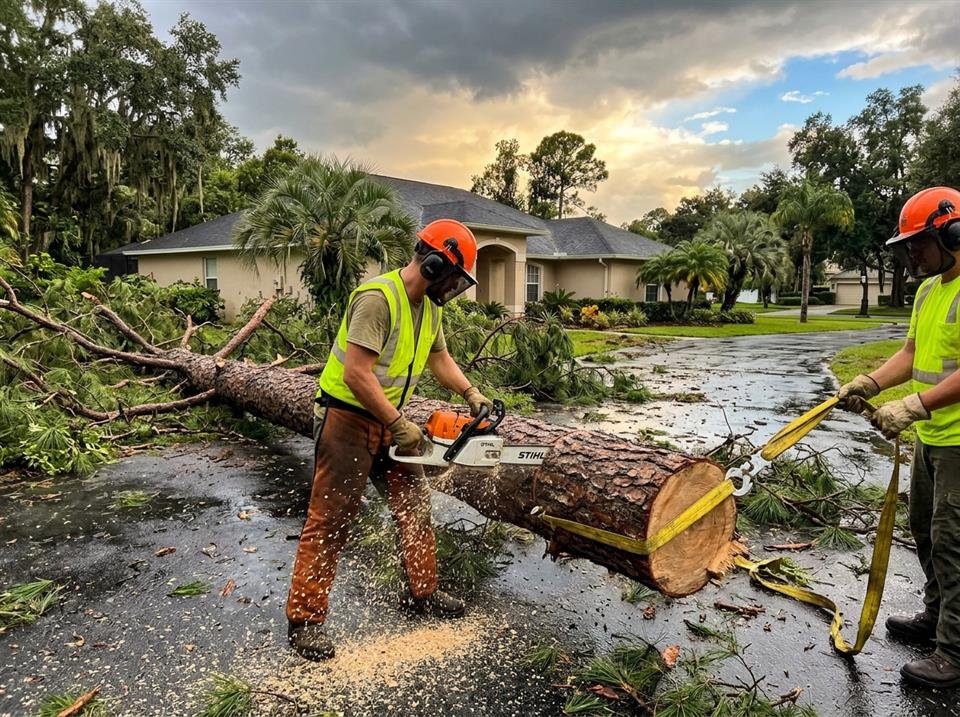
Professional Storm Damage Tree Service in Ocala, FL
Marion County occupies a unique ecological position in Central Florida. Although buffered from coastal storm surges, inland Marion County experiences intense tropical cyclonic wind bands, severe severe convective squalls, and microbursts that generate sustained winds between 60 and 115+ mph during major Atlantic hurricanes (such as Hurricanes Irma, Ian, and Idalia).
When high-velocity winds collide with Florida's dense hardwood canopies, property owners are left facing complex hazards. Finding reputable tree cleanup near me or safe tree cutting and removal requires arboricultural knowledge. Attempting to cut fractured, storm-loaded timber with homeowner chainsaws is one of the leading causes of post-storm catastrophic injuries across Florida. Our certified operations deliver safe, systematic clearance to protect your family and investments.
Why Florida Tree Species Fail Under Hurricane Forces
In our regional arboricultural practice, storm damage patterns vary dramatically based on the species, crown architecture, and underlying root health:
- Laurel Oaks (Quercus laurifolia) & Water Oaks (Quercus nigra): These fast-growing native oaks are prevalent in Ocala subdivisions built in the 1970s through 1990s. Both species possess weak compartmentalization mechanisms. By age 45 to 60, their heartwood frequently succumbs to internal fungal decay (often invisible from the outside). Under Category 1 or 2 hurricane winds (74-105 mph), these brittle trunks snap catastrophically mid-stem or split along weak codominant stem junctions.
- Live Oaks (Quercus virginiana): Live oaks are evolutionary marvels adapted to survive extreme hurricane forces. Their dense, interlocking wood fibers and spreading, low center of gravity allow them to bend under heavy gale loads. Failures in Live Oaks typically involve over-weighted, unpruned lateral limbs or instances where root zones were compromised by trenching, paving, or pool construction.
- Pines (Loblolly & Slash): Pines possess high flexibility, but in saturated soils their shallow root plates are vulnerable to complete windthrow. Under severe rotational gusts, pines may snap mid-trunk like matchsticks, spearing into nearby roofs.
- Saturated Karst Soil Mechanics: Ocala sits atop ancient limestone karst formations overlaid with porous, sandy soils. When tropical systems drop 8 to 14 inches of torrential rain, the sandy subsoil becomes liquefied. Saturated soil loses its cohesive shear resistance, allowing wind forces to lever the entire root ball out of the earth.
In the aftermath of a storm, broken branches hanging in the canopy—known in professional arboriculture as widowmakers—pose severe, unpredictable risks. High-tension electrical utility drops, telephone lines, and fiber-optic cables are frequently entangled within fallen brush. Under ANSI Z133 Safety Standards, treat all downed cables as energized high-voltage conductors until certified de-energized by the power utility. Do not attempt to pull branches away from tangled utility lines.
Commercial Post-Storm Equipment
Cleaning up hurricane debris requires heavy-duty industrial machinery to clear driveways and process multi-ton trees rapidly:
Restorative Pruning vs. Removal: Saving Damaged Canopy Trees
Not every tree that loses limbs in a hurricane needs to be condemned and bulldozed. Specimen live oaks, red maples, and southern magnolias often possess incredible resilience. In accordance with ANSI A300 (Part 1) Pruning Standards, our arborists evaluate whether a storm-traumatized tree can be safely preserved through scientific restorative pruning:
Bark Clean-Up & Tear Repair
Storm winds frequently rip branches away, leaving long, jagged strips of torn bark along the trunk. We excise ragged, dead bark margins with sterile tools, encouraging the tree's natural cambium to form smooth woundwood (callus tissue).
Subordination & Crown Balancing
When one side of a tree loses large scaffold branches, the remaining canopy becomes lopsided and aerodynamically unstable. We subordinate heavy lateral branches on the surviving side to restore symmetrical wind resistance.
Reduction Cuts to Lateral Limbs
Never "top" or round-over a storm-damaged tree. We make precision reduction cuts back to healthy lateral branches at least one-third the diameter of the parent stem, preserving internal vascular sap flow and stopping decay entry.
Navigating Florida Homeowners Insurance Claims for Storm Debris
Filing an insurance claim for fallen trees in Florida requires specific arboricultural proof. Most standard homeowners policies cover:
- Damage to Covered Structures: If a tree strikes your house, garage, pool enclosure, shed, or perimeter fence, the cost of removing the tree from the structure is typically covered under the dwelling/property coverage.
- Driveway Egress Blockage: If a fallen tree on your property blocks your driveway, preventing vehicular access to your home, most policies provide a debris removal allowance (often up to $500–$1,000 per tree) to restore driveway access.
- Debris on Open Lawns: Trees that fall on open lawns, pastures, or woods without damaging structures are generally not covered by insurance policies.
Our team provides comprehensive photographic evidence, itemized invoices distinguishing structural extraction from elective yard chipping, and certified statements to satisfy insurance adjusters.
Storm Damage Cleanup Cost Factors in Marion County
Post-storm tree work requires dynamic equipment setups and stringent safety protocols. Review our transparent breakdown of the primary factors influencing storm cleanup costs:
| Storm Cleanup Scope & Category | Typical Damage Profile | Equipment & Labor Required | Key Cost & Safety Drivers | Typical Timeline |
|---|---|---|---|---|
| Minor Yard Debris & Fallen Limbs Scattered branches, twigs, small debris |
Branches up to 4" diameter scattered across lawn and roof gutters | Ground cleanup crew, hand rakes, commercial leaf blowers, wood chipper | Total yard square footage, volume of brush to chip, hauling fees | 1 to 3 hours. Quick turnaround to restore lawn aesthetics. |
| Large Broken Limb Extraction (Widowmakers) Suspended 6"-16" branches over structures |
Canopy limbs cracked or hung up over rooflines, lanais, or driveways | Aerial bucket truck or tracked lift, friction rigging ropes, ground spotters | Height in canopy, rigging difficulty around fragile glass pool enclosures | 2 to 4 hours. Technical lowering to prevent collateral roof impacts. |
| Whole Tree Fallen on Open Lawn / Driveway Uprooted oak or pine on open ground |
Full-size mature tree (30'-70') uprooted by windthrow or snapped at base | Commercial chainsaws, mini-skid steer with log grapple, heavy chipper truck | Trunk diameter, species density, compression wood hazards, stump grinding needs | Half-day project. Full timber bucking, chipping, and log haul-away. |
| Complex Fallen Tree on Inhabited Home Structural puncture, truss damage |
Multi-ton trunk resting on roof, puncturing ceiling or supporting walls | Commercial knuckleboom crane, certified rigging specialist, emergency tarping crew | Crane setup access, critical weight balance, secondary collapse prevention, tarping | High-priority mobilization. Dedicated multi-technician operation. |
| Full Property Multi-Tree Disaster Clearing Widespread hurricane path destruction |
Multiple uprooted canopy oaks and pines across 1 to 5+ acre equestrian parcels | Excavator with root grapple, forestry mulcher, multiple grapple dump trucks | Acreage size, subterranean utility marking, timber salvage vs mulching | Multi-day commercial scale project. Complete landscape reclamation. |
Note: We maintain strict anti-price-gouging compliance under Florida emergency declarations. Estimates are based on transparent labor, machine time, and disposal rates.
Our 5-Step Post-Storm Tree Recovery Methodology
When recovering from a hurricane or severe squall in Marion County, our certified arborists execute a rigorous, standardized five-step procedure:
Site Assessment & Peril Isolation
We inspect the property for active hazards: energized utility drops, cracked root flares, and leaning trunks under mechanical load. We map exclusive drop zones before initiating work.
Canopy Hanger & Widowmaker Elimination
Aerial lifts and precision throw-line rigging are deployed to safely bring down all fractured branches loosely suspended in the crown, securing the ground work area below.
Controlled De-Tensioning & Bucking
Chainsaw operators make calculated plunge cuts and relief cuts to safely release stored tension in spring-poles and bent logs, preventing dangerous kickback and barber-chairs.
Mechanized Chipping & Timber Hauling
Brush is fed into commercial drum chippers, while heavy trunk logs are loaded onto haul trailers using low-ground-pressure grapple loaders to protect your lawn from rutting.
ANSI A300 Restoration & Final Rake
Surviving trees receive clean reduction cuts to seal torn bark. The entire yard, driveway, and roof surfaces are meticulously hand-raked and blown clean.
Storm Cleanup Services Across Greater Marion County
Our storm response trucks and equipment are dispatched throughout Marion County:
Frequently Asked Questions: Storm Damage Tree Service
Laurel oaks (Quercus laurifolia) and water oaks (Quercus nigra) are fast-growing, short-lived hardwoods (typically 50-70 years) with poor compartmentalization against decay. In Central Florida, mature specimens frequently suffer from hollow heart rot that remains hidden until hurricane-force gusts (74+ mph) exert massive rotational torque on the canopy, causing trunks to snap or shear off at the base. In contrast, native Live Oaks (Quercus virginiana) possess dense, interlocking spiral grain patterns that withstand high gale forces.
Yes, depending on the remaining canopy structure and trunk soundness. Under ANSI A300 standards, our arborists perform restorative pruning. We clean jagged bark tears, reduce end-weight on stressed limbs, and prune back to vigorous lateral branches at least one-third the diameter of the parent stem. If more than 50% of the functional live crown is destroyed or the primary trunk has split vertically, removal is typically recommended.
Marion County's karst topography consists of porous limestone beneath sandy-loam surface soils. When severe tropical storms drop 6 to 12 inches of rain, the sandy soil becomes saturated, losing its friction and shear strength. Gale winds act as an enormous lever on the leaf-dense canopy, prying the entire root plate out of the liquefied soil—a catastrophic failure known as windthrow.
Under Florida common law, when a healthy tree falls onto an adjoining property due to an Act of God (such as a hurricane or severe storm), the owner of the property where the tree landed is responsible for the damage to their own structures and the cleanup of debris on their side of the property line. However, if the tree was visibly dead, decayed, or neglected prior to the storm and the neighbor had received documented notice, the tree owner may be held liable for negligence.
Adjusters require clear, wide-angle and close-up photographs showing where the fallen tree impacted an insured structure, roof, fence, or blocked the driveway prior to any cutting. They also require an itemized invoice separating structural extraction from general yard brush cleanup. We provide detailed photographic logs, written scopes of work, and ANSI A300 risk evaluations to streamline claim approvals.
A "widowmaker" is a broken branch or tree top loosely suspended in the upper canopy. Even minor wind shifts can cause it to plunge to the ground without warning. Our crews never stand beneath a suspended limb; we use truck-mounted aerial lifts, compact tracked spider lifts, or throw-line high-tensile rigging to pull or lower the hazard safely before initiating ground cleanup.
We begin property triage immediately as sustained winds drop below safe operational thresholds (typically under 35 mph). Priority is given to emergency structural impacts, blocked driveways, and dangerous hung limbs threatening occupied buildings, followed by full yard brush clearing and wood chipping.
Yes. Our commercial cleanup packages include processing branches through high-capacity commercial drum chippers, hauling large trunk sections with grapple loaders, and thoroughly raking and blowing lawns and paved surfaces to leave your property safe, clean, and accessible.
Clear Storm Debris Safely with Marion County's Tree Experts
Do not let tangled limbs and fractured trees endanger your family or property. Request a transparent, on-site storm damage evaluation today.